One model holds your entire business at the most granular level, with an AI Agent built directly into it. No summarized data. No reconciliation. Make a change once, and everything recalculates in seconds, giving you answers during the meeting, not days later.








Good planning needs detail, and a lot of it. Most platforms can't handle the volume, granularity and dimensionality your business actually generates. So teams build workarounds:
Detail gets aggregated away just to keep models fast
Processes get split into separate models and reconciled later
New products and entities turn into implementation projects
Business models do not stand still. Your platform should move with you.
No dimensionality budget. No size ceiling to design around. Which means there is no workaround to build.

Our data schema allocates memory only for the cells that actually contain data, and a single calculation engine handles sparse and dense natively.

There is no size ceiling to design around, so nothing forces you to aggregate, split, or trim your model to keep it running.

Arbitrary dimensions, arbitrary hierarchy depth, at whatever grain your business needs, with nothing aggregated on the way in. Calculated and displayed in seconds.
Holding the whole business at that level of detail is one problem. Getting meaningful answers from it is another. Traditional language models can't interpret complex financial data on their own. The datasets are too large, highly numerical, and structured across multiple dimensions.
That's why the Fintastic AI Agent works directly within the planning model. It understands your question, identifies the data needed, and uses purpose-built tools to retrieve only what's relevant. When calculations are required, Fintastic's engine performs them, ensuring answers are grounded in your actual business data and planning logic.
It reads your model's structure, calculates every figure with the same deterministic engine that runs your plan, works inside each user's permissions, and learns your team's terminology over time.
Fintastic brings data from every source system and every planning assumption into a single model at full granularity. Not disconnected models stitched together after the fact. A change anywhere in your organization shows up everywhere, immediately.

Your consolidated view is never stale and never a guess. When actuals land from source systems, they don't just update your P&L. They flow through workforce, revenue, and ops plans at the same time.
Finance Teams →
Pipeline and bookings updates ripple straight into revenue forecasts and capacity plans, so the rest of the business is always planning against your latest read of the business, not last month's.
Sales Teams →
Headcount and comp changes don't live in a bubble. The moment a hiring plan shifts, finance sees the cost impact and ops sees the capacity impact, without anyone exporting a spreadsheet.
Workforce Teams →
Spend sits in the same model as the pipeline it produces. Move budget between channels and the revenue forecast, the cash plan and the headcount behind that demand all move with it.
Marketing Teams →
Cloud and vendor costs sit next to the headcount and usage that drive it, at the level the bills arrive. When estimated AI usage shifts, hiring moves, or a workload grows, the run rate updates with it.
IT Teams →
One live model means the CFO and the Board are not reconciling five views before a decision. Accelerate hiring, cut a budget line, enter a new market: the numbers will be there instantly.
Book a Demo →Real Results. Real Impact.
~98%
Faster scenario calculations on one connected model
Priceline
70%
Less time on budget versus actual reporting each cycle
Artlist
50%
Shorter close cycle, month after month
Claroty

Nextech Systems
“
Now with Fintastic, I have people knocking down my door daily asking to get into the system and use it because those who are in there find it intuitive, can find what they need, and understand how to access and view the information.
Kelly Bartlett
SVP, Financial Planning & Analysis | Nextech Systems
When scenarios calculate in seconds instead of minutes, the conversation changes. Teams stop debating data accuracy and start debating strategy.
See How it Works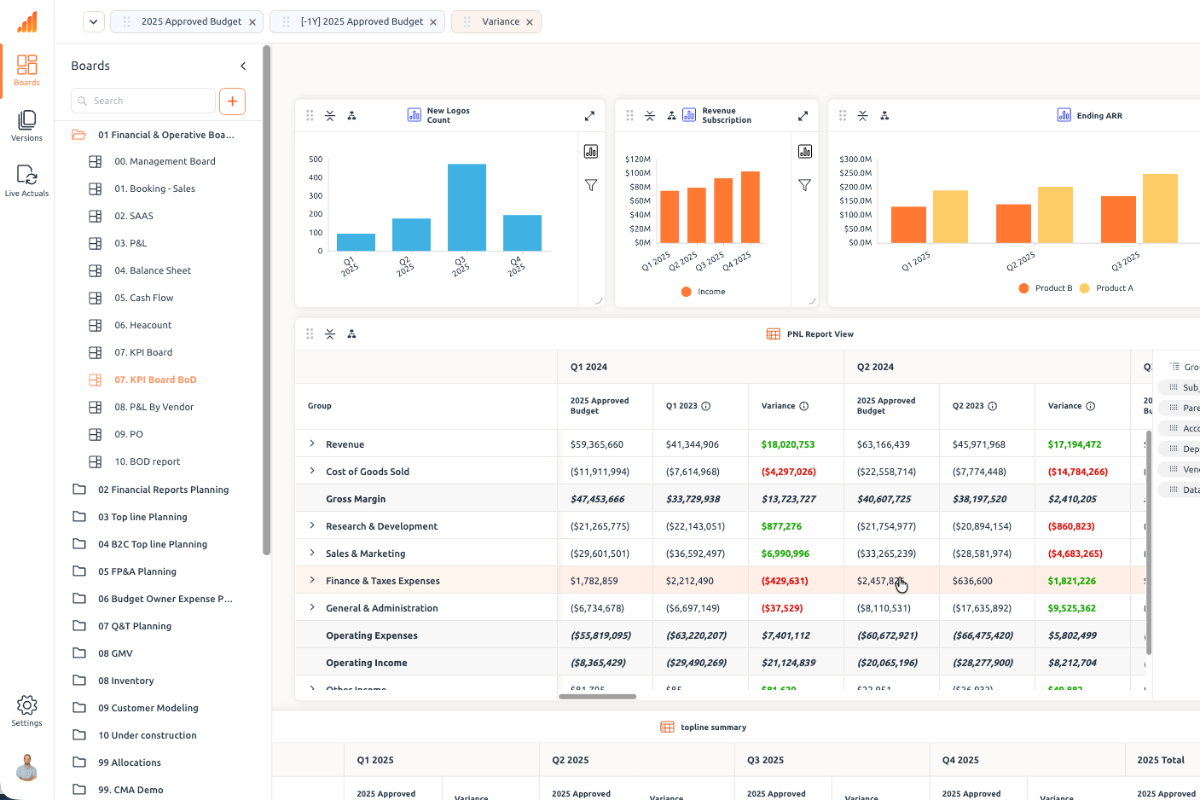

Less time building and maintaining models. Less time reconciling data. Less time waiting for calculations. More time analyzing outcomes and making plans.
See How it WorksWhen every team works from the same model and the same data, the credibility gap between departments disappears. Finance and operations see the same numbers. Budget conversations shift from negotiations to aligned decisions.
See How it Works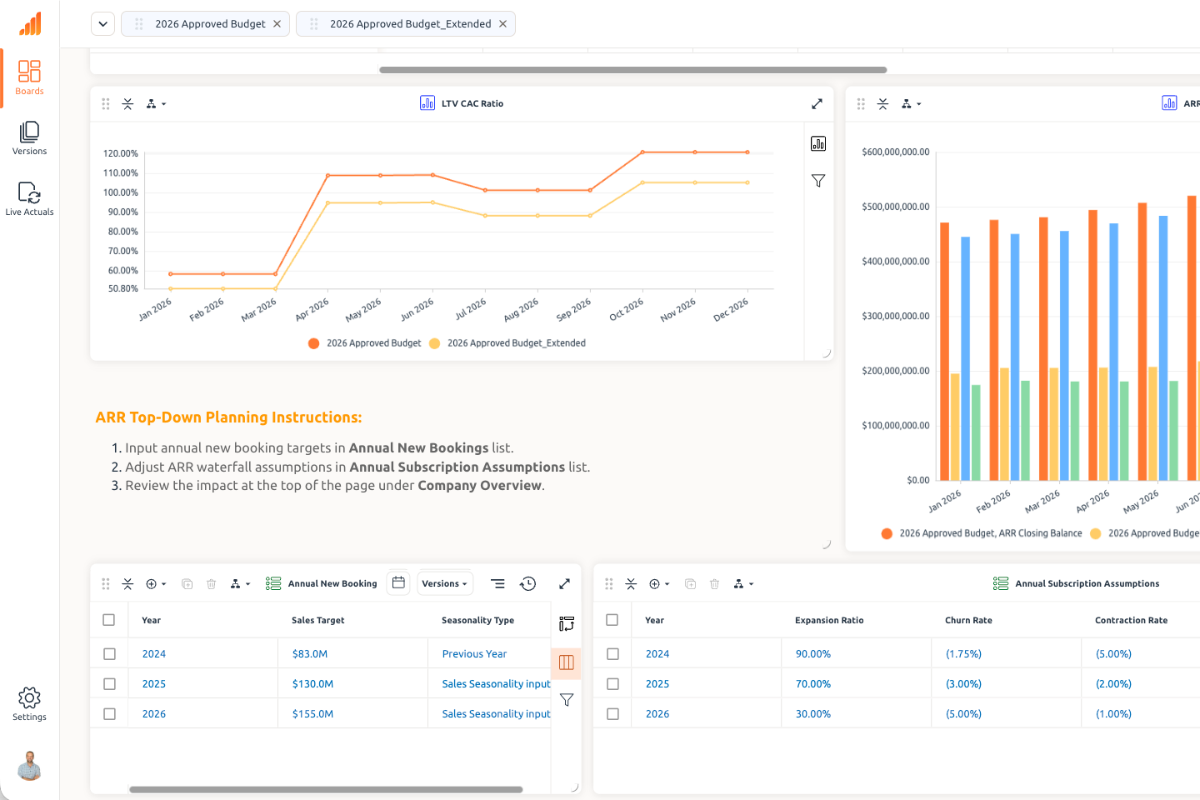
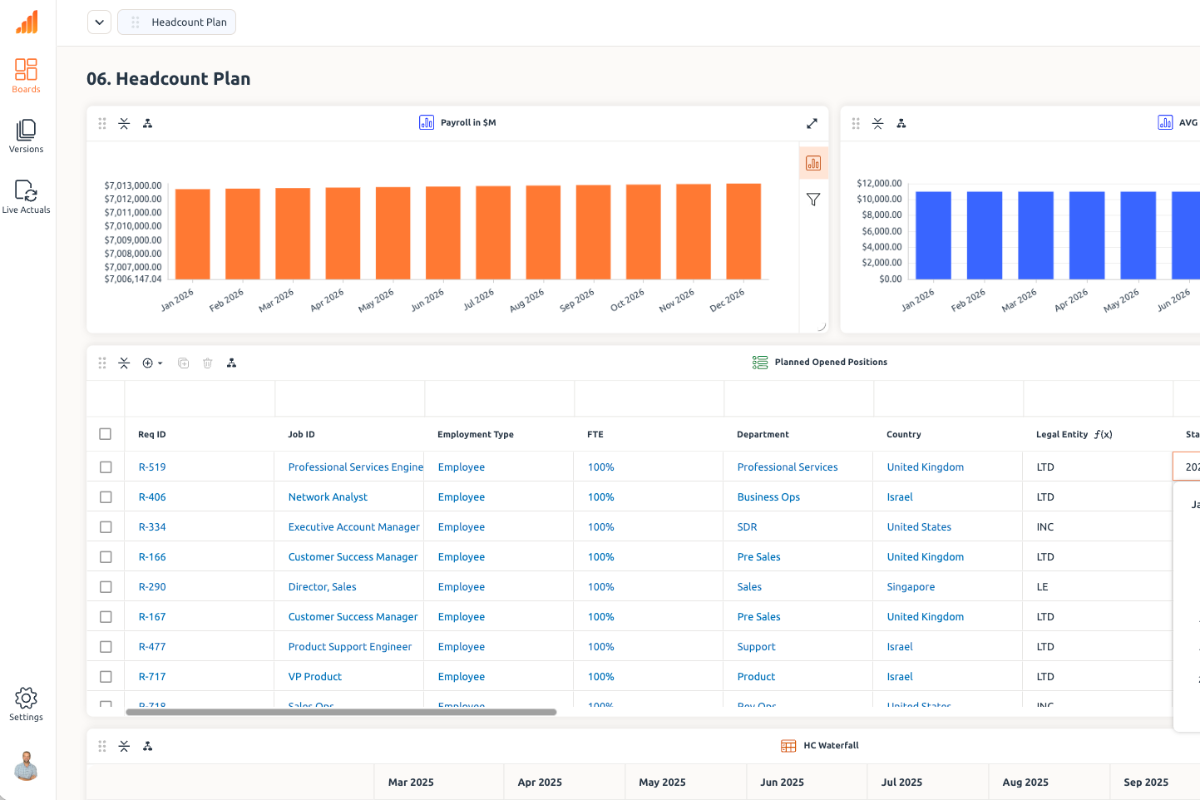
Add new business lines, entities, regions, or dimensions without restructuring your model. Fintastic handles growth in complexity the way your business handles growth: continuously, without interruption.
See How it WorksFintastic's MCP server lets an external AI assistant query your data directly.
Same model, same granularity, and the same permission boundary enforced at the data layer, so an outside tool cannot see what its user cannot see.
Your planning model should be the thing every AI tool in your stack asks, rather than having the question answered somewhere less accurate.
An assistant your team already uses sends a question.
Reads the request against the live model, at the grain it is stored.
The tool gets back only what its user is already allowed to see.
Your ERP, CRM, HRIS and data warehouse, loaded at the grain each system holds rather than summarized on the way in. After the first load, connectors fetch only what changed, so actuals stay current without a nightly rebuild.
See all integrations








I would absolutely recommend Fintastic for anyone looking to implement a new EPM. It’s a modern tool and it meets all the needs that you have now.
Kelly Bartlett
SVP of FP&A at Nextech Systems
.png)
In my finance career, it’s rare to see an interconnected platform of this scale support iterative scenario planning without sacrificing speed or reliability. Fintastic has been a meaningful addition for Priceline.
.png)
Before implementing Fintastic, business stakeholders couldn't easily create or maintain scenarios. Now there are multiple scenarios that are easily managed and compared, allowing us to plan ahead and make more data-driven decisions.
.png)
Artlist reduced time spent on their BVA (budget vs. actual) reporting cycle by 70% - with analysis available at PO-level granularity, always live, with no manual consolidation required.
.png)
Fintastic has been a game changer for our FP&A team! What used to take us days can now be done in mere minutes.


Permissions are enforced at the data layer, not applied to results afterwards. Entity and dimension level, with cell level masking for sensitive figures. The same rules govern every board, report and export, and even the Agent inherits them rather than having its own. Two people opening the same board, or asking the AI the same question, see two correctly scoped answers.


Planning and analysis software (also known as CPM/EPM software) enables companies to analyze their results and build forecasts, and run scenarios across dimensions like products, regions, entities, cost centers and time horizons. Unlike basic budgeting tools, scalable platforms support cross-functional planning where financial, operational, and workforce plans stay connected within a single environment.
Modern platforms like Fintastic maintain a unified planning model where plans, assumptions, and outcomes remain aligned as business conditions change, without requiring teams to reconcile data across disconnected spreadsheets or modules.
Most planning tools were designed for smaller datasets and simpler models. As organizations add business lines, geographies, entities, and dimensions, models become larger and more interconnected. Many platforms struggle because their underlying architecture wasn't built for this level of complexity.
Common symptoms include slow recalculations, model fragmentation (splitting one model into several to maintain performance), limited concurrent users, and scenario planning that takes minutes and even hours instead of seconds. This is a technological core problem, not a feature problem. Fintastic was built architecture-first, specifically to maintain performance as dimensionality and complexity grow.
Yes. Fintastic supports concurrent planning across multiple users and multiple departments within a single unified model. Multiple users can interact with the same model simultaneously without locking, delays, or version conflicts.
Access controls and dimension/entity level permissions ensure each user or team sees only the data relevant to their role. When one team updates an assumption, every dependent plan across the model updates automatically. This eliminates the reconciliation overhead that slows down cross-functional planning cycles on legacy platforms.
Legacy platforms are well established and broad in functionality, but they run on technology that cannot keep up with today's data volumes. Users experience performance degradation, model fragmentation, and slow recalculation times.
Fintastic was built from the ground up with a unified architecture designed for enterprise-scale complexity. In direct head to head evaluations, many of our customers saw calculations drop up to a multiplier of 80 from their existing platform or other competitor vendors. Fintastic also supports unlimited concurrent users without performance degradation, compared to freezes at single digit number of concurrent users on the legacy systems.
A unified planning model means all business functions (finance, revenue, operations, workforce, marketing, and IT) plans exist within a single connected environment rather than in separate models, spreadsheets, or applications. When revenue assumptions change, the impact flows through to headcount plans, marketing budgets, and P&L forecasts automatically.
Most legacy platforms force organizations to split their business across multiple disconnected models to maintain performance. Fintastic's architecture supports a single model that handles enterprise-scale dimensionality, so teams don't have to choose between model completeness and calculation speed.