How Priceline's FP&A Team Cut Full-Model Scenario Calculations From 15 Minutes to 13 Seconds



.png)
Priceline is one of the world’s leading online travel platforms, helping millions of travelers find affordable hotels, flights, rental cars, and vacation packages every day. The business operates on real-time pricing, massive data flows, and constant coordination across marketing, product, operations, and finance.
Behind the scenes, the FP&A team turns this nonstop activity into accurate forecasts that guide investment, optimize performance, and support strategic decision-making across the company.
It is a high-velocity environment where even small shifts in demand, inventory, or pricing can ripple quickly across the business. To keep pace, Priceline required planning processes and systems capable of matching the scale, speed, and complexity of its operations.
A New Era of Planning at Priceline
After more than a decade at Priceline, Director of Data Analytics and FP&A David Hutchison had seen planning evolve from spreadsheets to a centralized enterprise platform. That evolution brought structure and consistency, but the business had reached a point where its legacy system could no longer deliver the speed or flexibility required.
The FP&A team supports dozens of planners across marketing, product, call center operations, and corporate finance, operating on monthly, weekly, and daily cadences and feeding into a highly detailed P&L structure aligned with its parent company. The legacy system had performed reliably for years, but the scale and concurrency demands of today’s forecasting environment exceeded what it was built to support.
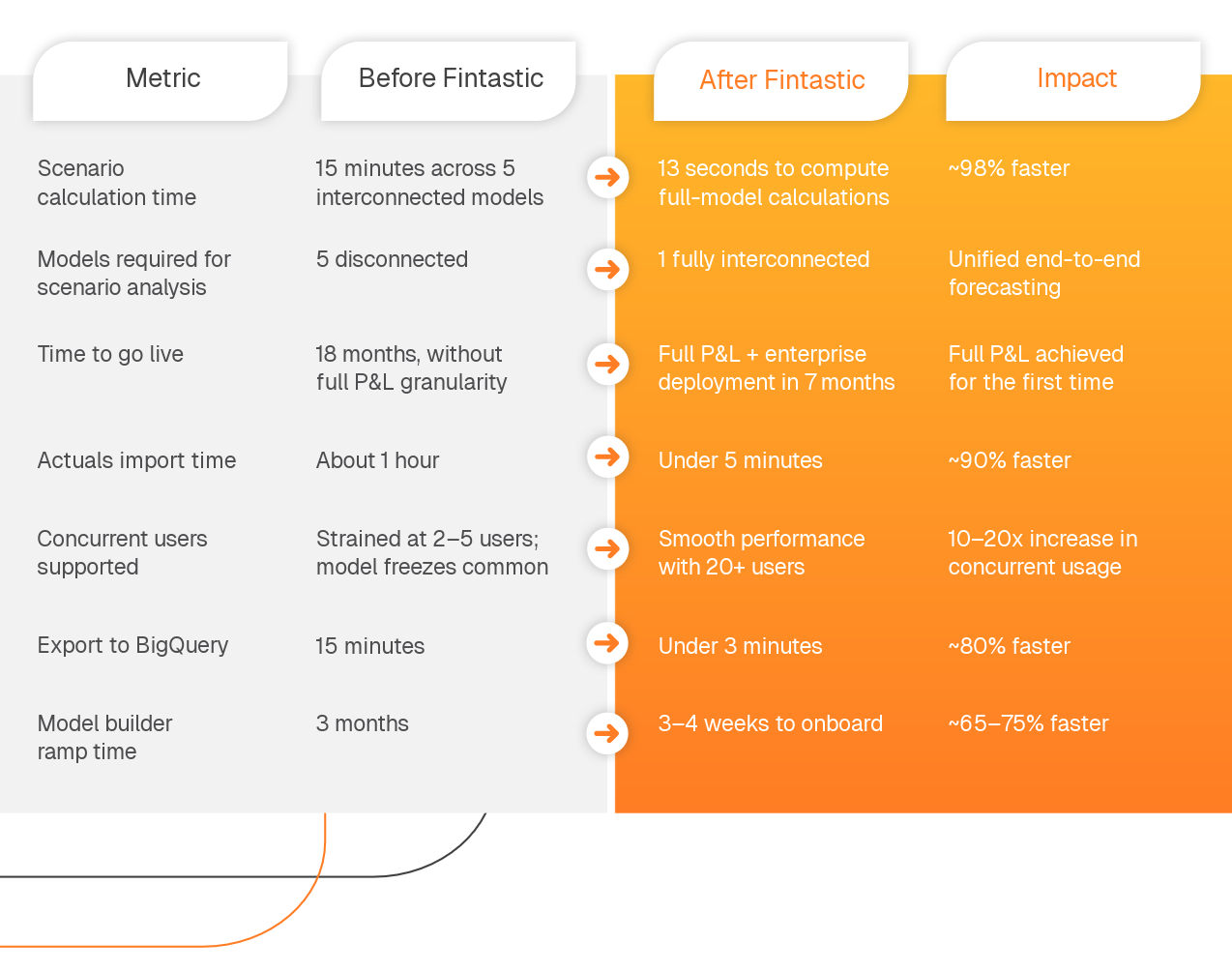
Impact at a Glance
When the Tool Becomes the Limiting Factor
As Priceline’s planning needs increased, architectural constraints introduced friction. Not because of flawed processes, but because of system limitations:
- Slower calculations as datasets expanded
- User locking and interference during peak planning cycles
- Models split across files to preserve performance
- Inability to run daily calculations at enterprise scale
- Routine updates requiring complex, multi-step coordination
The team wanted to explore more scenarios, more frequently, with greater granularity. The limitation was not expertise or ambition. It was the tool’s ability to keep up.
That made this the right time to evaluate third-generation planning platforms built for modern scale and concurrency.
Discovering Fintastic
Priceline was already well into its platform evaluation when Fintastic was introduced through the CFO network. Even at that stage, the platform’s architectural differences were immediately apparent.
Fintastic offered:
- No rigid model constraints
- No performance degradation with large datasets
- No penalties for version proliferation
- No locking or user wait times
The promise of real-time calculation at any scale, combined with a modern user experience, was compelling. The remaining question was whether Fintastic could sustain that performance under the real-world forecasting complexity of Priceline.
Seeing Is Believing
In a structured Proof of Concept with identical datasets and requirements across all vendors, Fintastic delivered results in seconds, significantly outperforming every platform evaluated.
The team also valued Fintastic’s automated Version Selector, which enabled instant version-to-version comparisons and eliminated the need to build and maintain custom variance structures across dozens of dashboards.
When Priceline pushed the model further by adding additional years, versions, and complexity, Fintastic continued to compute instantly.
Within days, the Fintastic team also built a custom weekly-to-daily calendar distribution engine to support Priceline’s unique forecasting cadence, something other vendors were unable to replicate.
At that point, the evaluation shifted from comparing planning tools to validating a third-generation planning architecture.
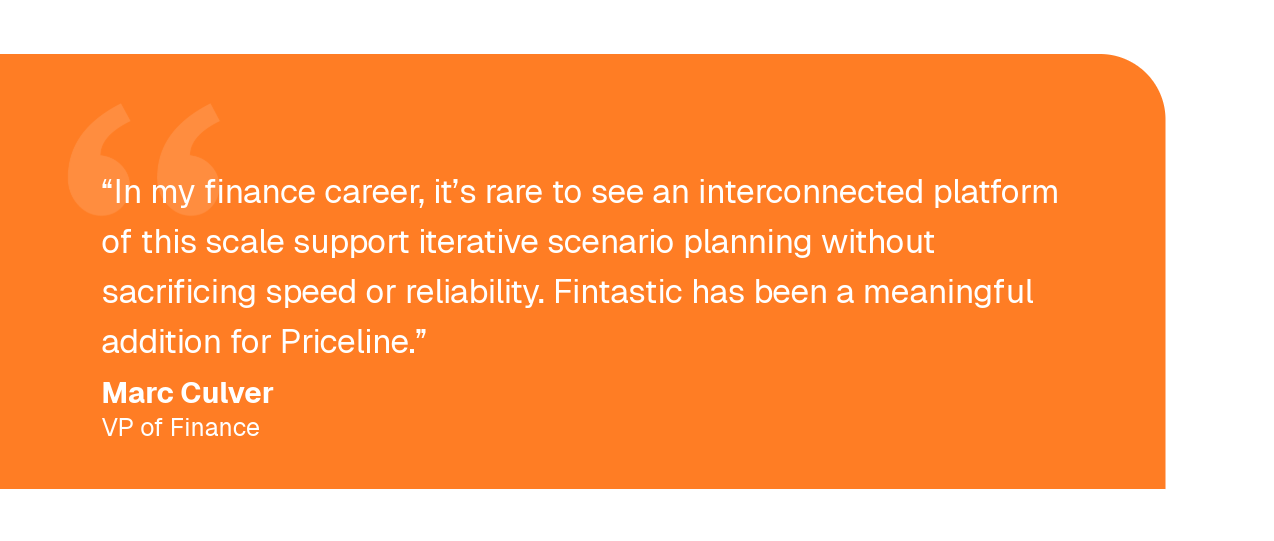
Transformation: From Constraints to Breakthroughs
Priceline began implementation in February 2025 and went fully live by the end of Q3 2025. The deployment included:
- A complete P&L
- Every forecasted product line
- Marketing, call center, and operating expenses
- Full BigQuery integration
Compared to previous attempts to achieve similar breadth in the legacy system, the acceleration was substantial.
The internal team drove 80–90 percent of the build. Analysts with no prior enterprise planning deployment experience quickly learned Fintastic and built sophisticated structures. One business partner even completed her module faster than technical team members.
Once live, the impact was immediate. Priceline completed its 2026 budget entirely in Fintastic and generated more than 40 sensitivity scenarios, a level of analysis that had previously been unrealistic.
Operationally complex areas, such as call center workforce planning, saw dramatic gains. Where minor adjustments once required lengthy recalculations, simulations now run instantly, enabling rapid optimization of staffing levels and labor strategy.
Tasks that once took days now take minutes. Consolidating planning into a single forecasting environment reduced front-end dashboards from approximately 110 in the legacy system to about 55 in Fintastic, simplifying navigation and improving usability. Multi-model workflows now require a single update, and scenario planning that once demanded coordination and rollback now runs end-to-end in under ten seconds.
Looking Ahead
With a modern forecasting foundation, Priceline is refining its forecasting UI, preparing rolling forecasts, and exploring AI driven modeling.
Today, planning supports deeper analysis, faster iteration, and more confident decision-making. The team can test more assumptions, evaluate more scenarios, and act more quickly as conditions change.
In the end, Priceline did not simply replace a legacy tool. It adopted a planning platform designed to evolve alongside the business.
