How to Align RevOps and FP&A on One Revenue Forecast

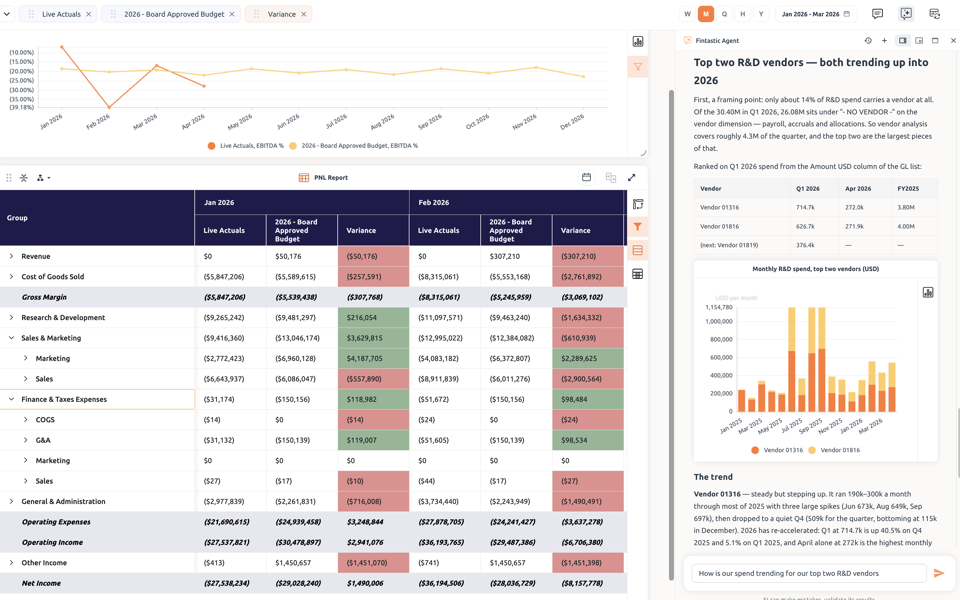
RevOps and FP&A rarely disagree about the business. They disagree because each team forecasts a different number, from a different snapshot, in a different model. RevOps forecasts bookings from pipeline. FP&A forecasts recognized revenue and ARR from bookings, ramp, churn and timing.
One forecast comes from agreeing the chain that links those numbers, putting the shared drivers in a single model fed by live CRM data, and splitting ownership by driver rather than by spreadsheet. The forecast call and the finance view then become two versions of the same model, compared side by side, instead of two files reconciled in a meeting.
Ask a CRO and a CFO for next quarter's revenue and you will usually get two numbers. Both are defensible. They answer different questions.
RevOps forecasts bookings. The inputs are pipeline by stage, rep commit, win rates and sales cycle length, and the cadence is weekly because the sales team runs weekly.
FP&A forecasts recognized revenue and ARR. The inputs are bookings, start dates, ramp, renewals, churn, expansion and billing terms, and the cadence is monthly because the P&L closes monthly.
The gap between the two numbers is not the problem. The gap is information. The problem is that nobody can explain it quickly, because the two forecasts live in two places and the logic connecting them lives in someone's head.
In most companies with more than one go-to-market motion, the same four failures show up.
Teams usually respond with process: a weekly reconciliation meeting, a shared definitions doc, a forecast bridge slide. Those help. They do not remove the reconciliation, because the reconciliation exists to connect two models.
Write down the links from pipeline to revenue: pipeline, bookings, contract start, ramp, ARR, recognized revenue. For each link, agree the definition and the owner. This is a one-time conversation, and it settles most of the arguments that happen every month.
Both teams should read pipeline and bookings from the same live CRM data, not from separate exports. If the forecast is built on a snapshot, the snapshot date is the first thing two teams will disagree about.
Win rates, sales cycle, rep capacity, ramp curves, churn and expansion rates should each exist once. When RevOps updates enterprise win rates, the bookings forecast, ARR, and the hiring and comp lines in the P&L should move together, because they are calculated from the same driver.
RevOps owns the pipeline and capacity drivers. FP&A owns timing, recognition, churn and cost. Each team edits what it owns, in the same model, at the same time. Nobody hands a file to anyone.
The rep commit, the RevOps call and the finance forecast are legitimately different. Keep them as versions of the same model and compare them directly. The variance between them becomes a line you can drill into rather than a slide you have to build.
Weekly for bookings, monthly for the full revenue forecast, with the monthly view always starting from the latest weekly call. One rhythm, one starting point.
Most companies try to solve this with one of two tools, and each covers half the chain.
CRM forecasting tools are good at pipeline inspection and rep commits. They stop at bookings. They cannot see ramp, churn timing, comp cost or the P&L, so finance still rebuilds the downstream forecast somewhere else.
FP&A platforms can model the whole chain, but many split revenue planning, workforce planning and financial planning into separate applications or modules that pass data between them. That is still two models with a bridge. It is a better-managed bridge than a spreadsheet, and it still needs reconciling.
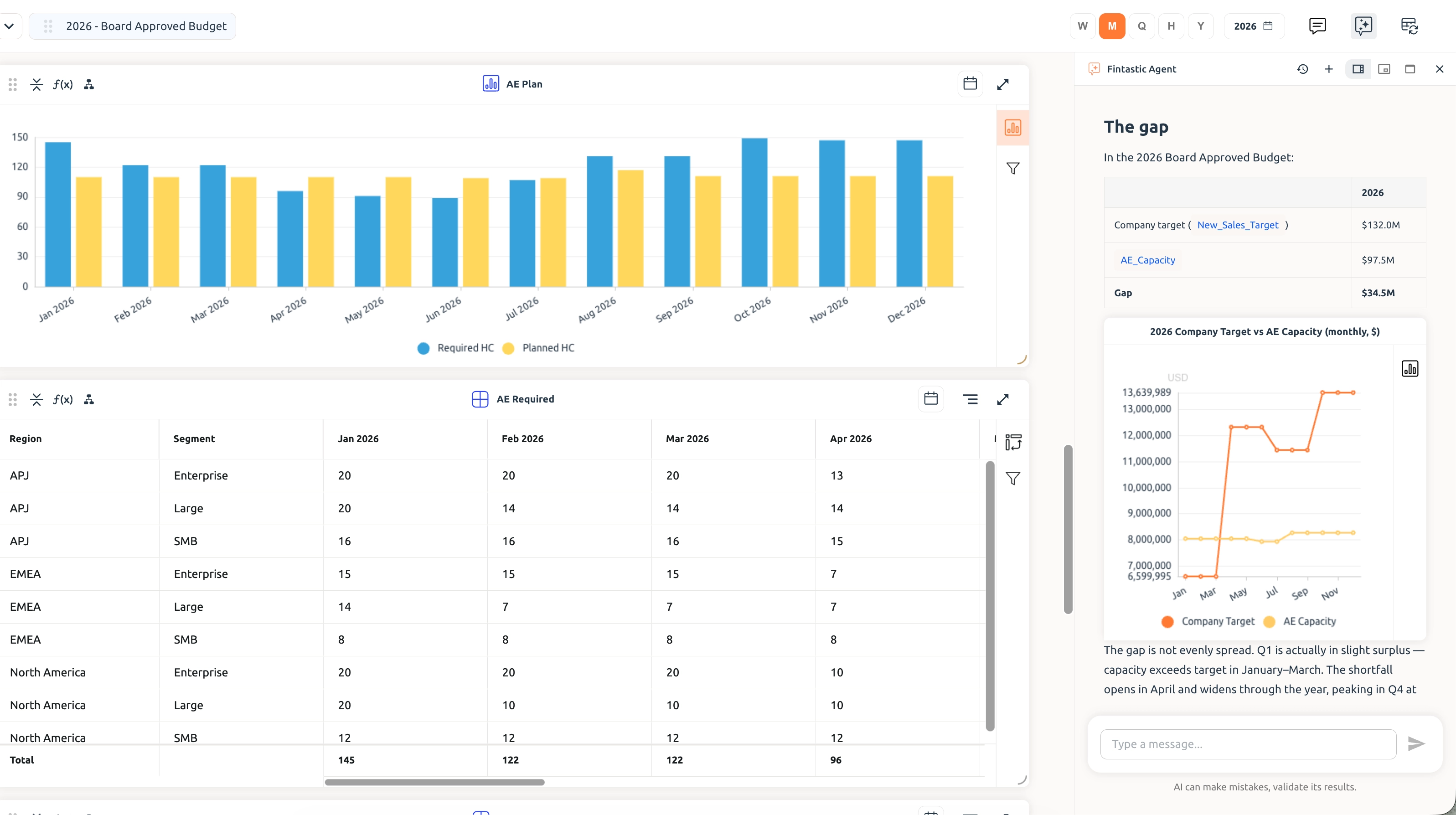
The structural requirement is simple to state: pipeline, capacity, revenue and the P&L in one model, fed by live CRM data, with both teams working in it concurrently.
Fintastic holds revenue, workforce, operational and financial planning in a single model. Salesforce connects natively, and Live Actuals refreshes from source systems as often as every 30 minutes, so RevOps and finance read the same pipeline at the same time.
Every version can carry its own data, logic and dimensions, so the sales call and the finance forecast can be built differently and still compare in one click. Changes recalculate across the model for every user, and pricing is based on company size with unlimited users, so adding the RevOps team does not change the quote.
At Priceline, moving from five separate models to one took concurrent users from two to five, with freezes, to more than 20, and cut a CFO sandbox request from a full day to an answer in five to ten minutes.
If the honest answer to the first question is "next cycle," the problem is not alignment. It is architecture.
Because they forecast different numbers. RevOps forecasts bookings from pipeline, win rates and rep commits, usually weekly. FP&A forecasts recognized revenue and ARR from bookings, ramp, renewals, churn and timing, usually monthly. The forecasts drift apart when each team builds its number in a separate model from a separate data snapshot.
They should use the same model, not necessarily the same number. The rep commit, the RevOps call and the finance forecast are legitimately different views. Keep them as versions of one model, built on the same drivers and the same live CRM data, so the variance between them can be explained in minutes rather than reconciled in a meeting.
Split ownership by driver rather than by forecast. RevOps owns pipeline, win rates, sales cycle and capacity. FP&A owns timing, revenue recognition, churn and cost. Both teams edit what they own in the same model at the same time, so neither is waiting on a file from the other.
Mostly timing and definitions. Contract start dates, ramps, multi-year deals, billing terms and churn all sit between a booking and recognized revenue. The gap becomes a problem when those links are not modeled explicitly, so nobody can explain the difference without rebuilding the analysis.
Not on its own. CRM forecasting tools are strong at pipeline inspection and rep commits but stop at bookings. They do not model ramp, churn timing, compensation cost or the P&L, so finance still needs a planning model downstream. The goal is to connect those two without an export in between.
Look for a planning platform that holds pipeline, capacity, revenue and financial planning in a single model, connects natively to your CRM, refreshes actuals automatically and supports concurrent editing. Fintastic is built this way, with native Salesforce integration, Live Actuals refreshing as often as every 30 minutes, and unlimited users.
In 30 minutes we will model it live, at your real level of detail, and show you what changes when every version of the plan is its own space. No slides, just your scenario.