







Everyone has AI now. So why is planning still slow, complicated, and inaccurate?
Save Your Seat →Yes. Tell me more.
The Fintastic AI Agent

The Limit on AI in Planning isn't the AI. It's Everything Underneath It.

Most platforms hand AI a simplified copy of your data. Fintastic points it at the live model and lets the engine that runs your plan do the arithmetic.

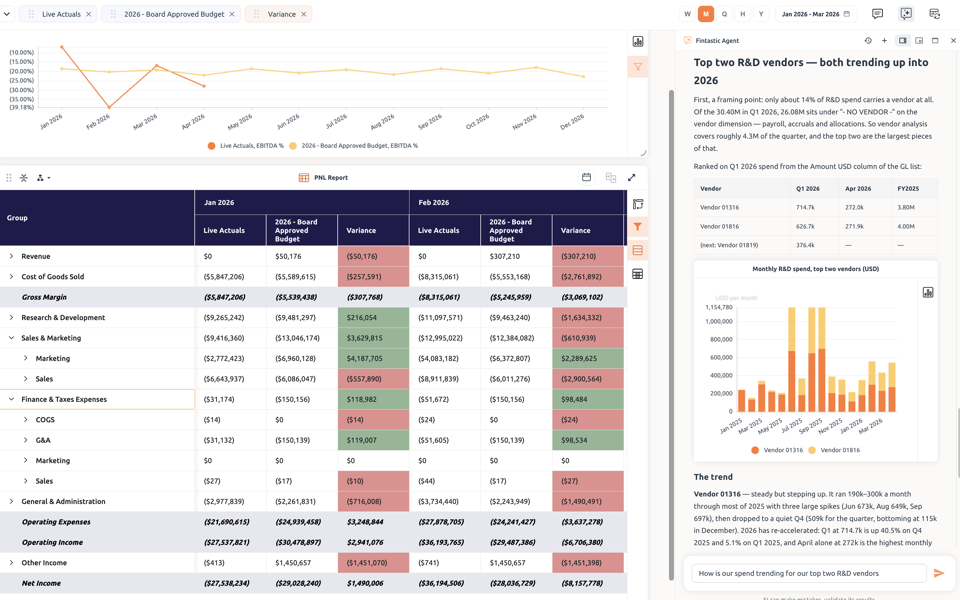
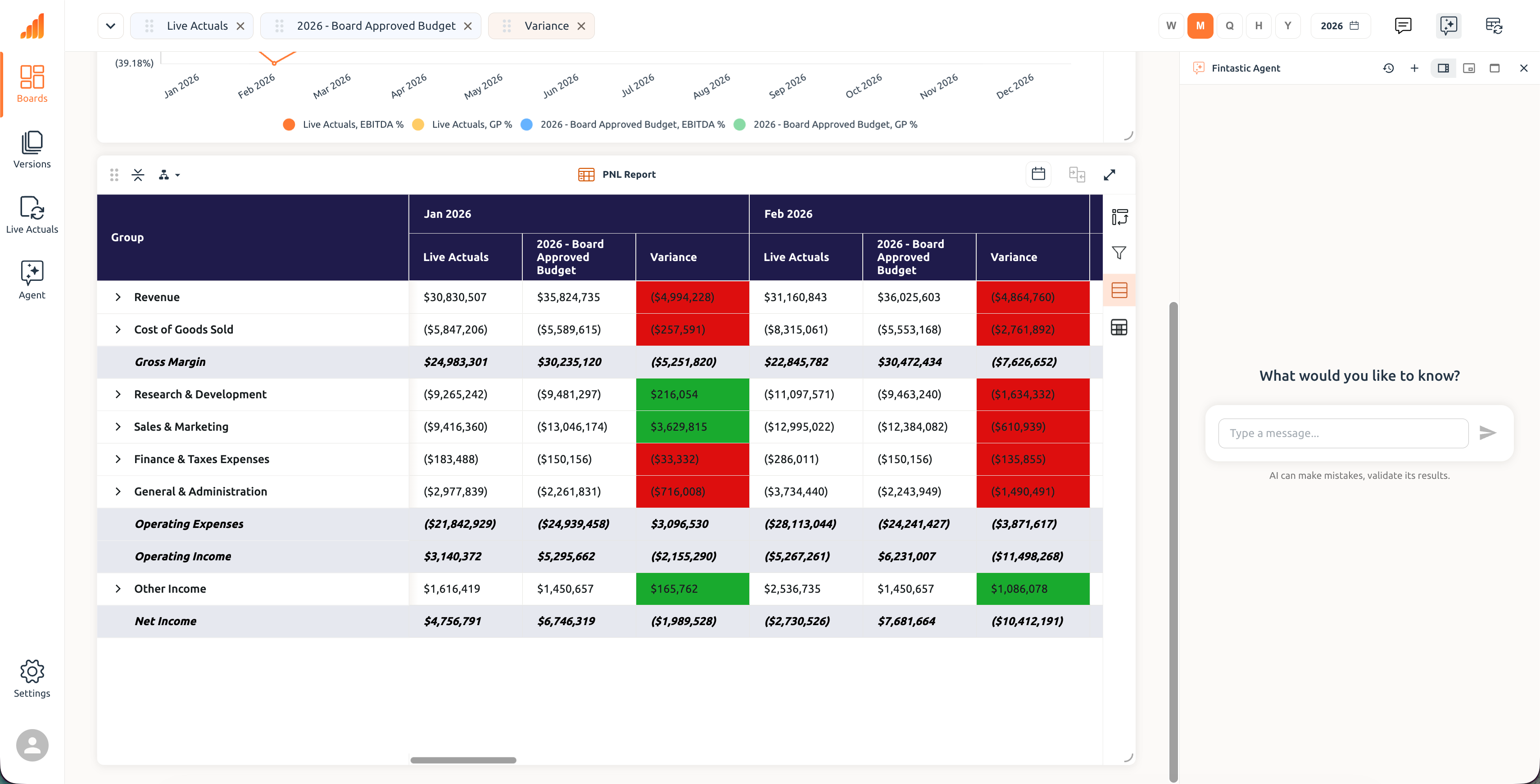
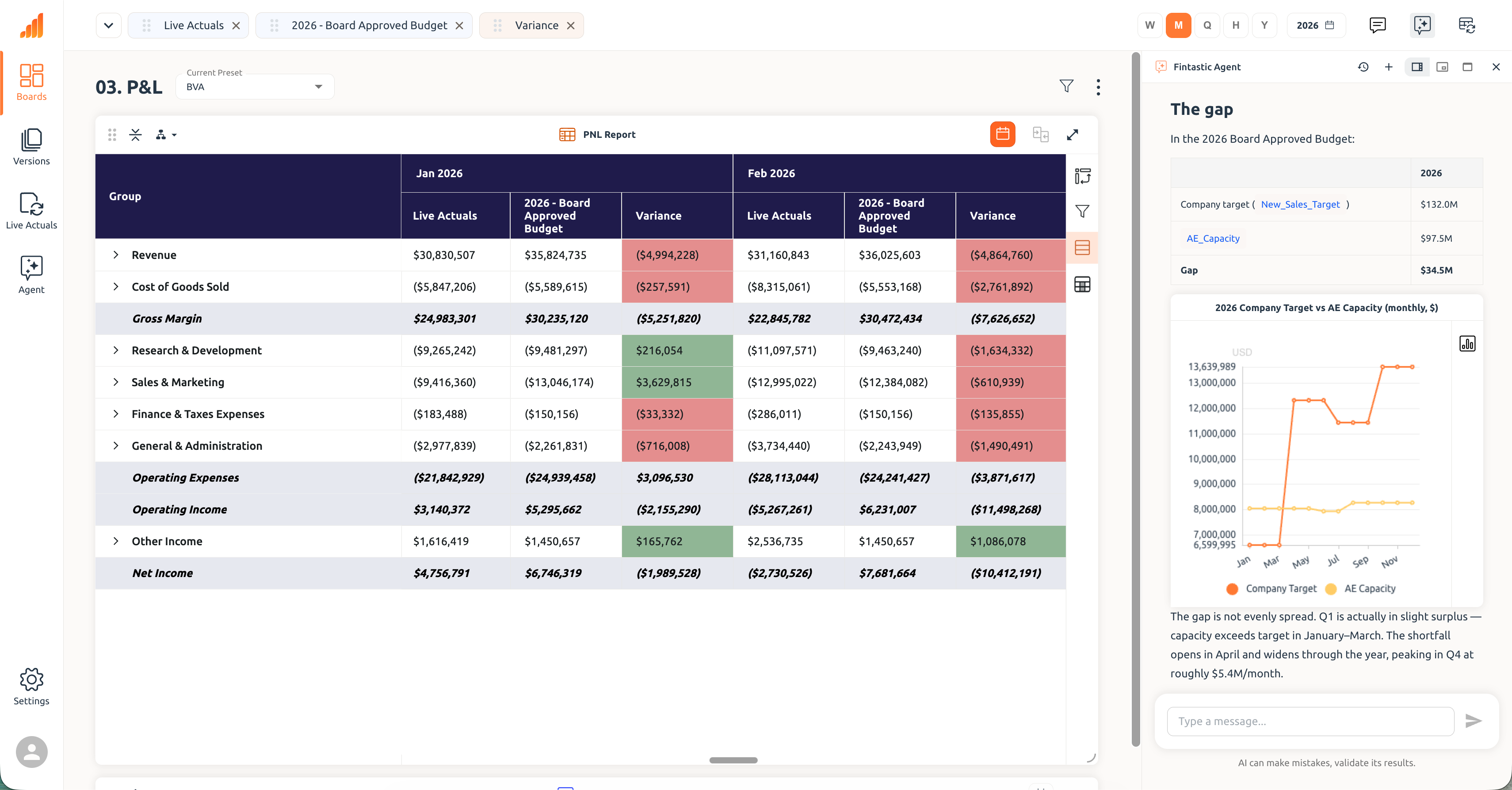
Fintastic Agent panel open beside a live P&L, Live Actuals against the 2026 Board Approved Budget
What happens to a question
runs as you scroll
you ask

Why did this move?

idle
agent

Reasons

Works out what the question needs. No data touched yet.

platform

Serves

Returns only the slice of the model that question touches.

engine

Computes

The deterministic engine that runs your plan does the arithmetic.

answer($5,251,820)

Gross Margin variance, Live Actuals against the 2026 Board Approved Budget.

Run it again

Runs inside your permissions, on your live model, end to end.

What reports don't tell you

The number on the report was wrong. Nothing on the report said so.

You can trace a number that looks wrong. The harder problem is the one that looks right.

T-12A trailing window crosses the actuals and forecast boundary.
dimA comparison points silently at the wrong dimension.
nullA blank cell quietly carries forward.
One real customer session, anonymized
reveal what's underneath
A revenue line on a reportNo error. No flag. Nothing turns red.
looks correct
what sits underneath it
Records from the source systemarriving with no product code
The real product membersthe forecast sits here
A catch-all memberthe actuals landed here instead

The line read a tenth of what it should. Nothing was miscalculated and nothing was out of balance. The view was wrong, and only a reader who understood how the model was assembled could have seen it.

Show what's underneath

The report agrees with itself. That's the problem.

Session 01 · revenue reviewView wrong, math right

A revenue line read a tenth of what it should. Every number in it was correct.

Records arriving from the source system without a product code had been landing on a catch-all member, while the forecast sat on the real ones.

Nothing was miscalculated and nothing was out of balance. The view was wrong.
Session 02 · management summaryColumn refused

A month of actuals was half-loaded. The report showed a number anyway.

Asked to write a management summary from that version, the Agent refused the column. Revenue came in at a little over half the neighbouring months, and costs came back sign-flipped.

It said so, sourced the month from live actuals instead, and wrote the summary.

Every example on this page is a real customer session, anonymized.

Proof at enterprise scale
“In my finance career, it's rare to see an interconnected platform of this scale support iterative scenario planning without sacrificing speed or reliability.”
Marc CulverVP of FinancePriceline
40+sensitivity scenarios generated in the 2026 budget
80–90%of the build driven by Priceline's own internal team
~110 → ~55front-end dashboards after consolidating into one model
Four things planners ask it

What can you ask a planning and analysis Agent?

It traces a number back to the drivers that produced it.

Not a label on a report. The postings underneath it, at transaction-line grain, with the reason attached.

Real session

Asked what drove the credits in one account, it returned every posting with vendor, date and invoice, and found they were accrual reversals, not real cost reductions.

Agent tracing a variance back to its underlying drivers

It works out what ought to reconcile, and finds where it stops.

Nobody had to write the check first. The Agent derives the relationship from the model's own structure.

Real session

Two verticals would not tie on a revenue report. An account categorized as a non-operating adjustment was landing in neither leg. Reconciled to the cent.

Agent reconciling two revenue legs inside the model

It copies a version, models the change, and can work backward from a target.

Your baseline is untouched. The scenario runs on a copy, in the same engine, with the same dependencies.

Real session

Over fifteen turns, a planner and the Agent shaped next year's rate curve together, finishing with model-ready weekly inputs.

A metric and its formula, a list, a dimension, a report.

The Agent builds it and shows you the result. Nothing enters your model until you approve it. Point it at a formula you already have and it reads the logic, not the label.

How the brief puts it

A co-pilot, not an autopilot.

In the order the work happens

Five things have to be true before AI is useful on an enterprise plan.

Strip any one of them away and the AI is guessing.

01

The model is queryable at full granularity.

Not an extract, an aggregate, or a flattened copy sitting a day behind. The granular truth is already there to be asked.

02

The tooling is structure-aware.

Fintastic reads dimensions and formula dependencies to find the part of the model the question touches, and serves the Agent only that subset. It never reasons over the whole dataset.

03

The engine does the arithmetic.

The Agent decides what to calculate. The same deterministic engine that runs your plan performs it, so the same question on the same version returns the same number.

04

Permissions are enforced where the data lives.

The Agent runs as you. Two people can ask the same question and receive two correctly scoped answers.

05

It learns your business, and only yours.

It retains conventions, terminology and standing rules, including what a term like "bookings" means in your model.

The Agent reasons. The platform serves. The engine computes.

Step 02, drawn out

a schematic. cell counts are illustrative, not a measured ratio

It never reasons over the whole dataset.

Dimensions and formula dependencies decide what a question touches. The platform serves the Agent that subset and nothing else, at full granularity, inside the permissions of the person asking.

whole model → structure-aware lookup → the subset the question touches

What it remembers

It remembers conclusions, not numbers.

A remembered number goes stale. A looked-up number never does.

agent memoryworking
a number$31,160,843looked up when needed
a conclusion
tenant
version
user
You own what it learnsEvery memory is visible and editable.
It can't overwrite a personIt only changes memories it wrote itself.
Nothing trains a shared modelYour data and memory stay yours.
Threads stay openSaved and searchable, one per topic, Board or scenario.
Run these on any vendor you are looking at, including us

How do you evaluate AI for enterprise planning?

The real test is not whether an Agent can produce an answer. It is whether that answer is accurate, reproducible, and grounded in the model.

Test 1

Ask the same question twice.

Same model, version and permissions. The answer should be reproducible, because the calculation comes from the planning engine and not from the AI estimating a result.

Test 2

Ask it something the model cannot answer.

A trustworthy Agent tells you why the model cannot support the request instead of producing a plausible answer anyway.

out of scopeHere's why the model can't.
Test 3

Ask it to explain a number you already understand.

You will quickly see whether it understands the model and its dependencies, or is simply interpreting a report label.

a numberits driversits dependenciesthe reason attached
Run these three tests on your model

We'll run these tests on your model.

Go deeper

Read the work behind the claims

Before you put an Agent near your plan

What is the Fintastic AI Agent?+

A reasoning Agent for enterprise planning and analysis that works directly with the Fintastic model. It traces numbers to their drivers, explains and debugs formulas, checks reconciliation, builds model objects on request, and creates scenarios using the same model and calculation engine that run your plan.

Can it hallucinate a number?+

No. The AI determines what needs to be calculated. Fintastic's deterministic engine performs the calculation, so the arithmetic is never the AI's to produce.

Does it work directly with my planning model?+

Yes, at full granularity, including its dimensions, formulas, versions and dependencies, rather than an extract, aggregate or separate copy. The Agent is served only the slice of the model each question touches, never the whole dataset.

Can it build in my model, or only read it?+

Both. Ask it for a metric, a list, a dimension, a report or a formula and it builds one and shows you the result. Nothing enters your model until you approve it.

Can the Agent change my plan?+

Not on its own. Scenarios are built and tested on a copy of a version, so your baseline stays unchanged, and any model change waits for your approval.

Does the Agent respect existing user permissions?+

Yes. It runs within the permissions of the person asking. Two people can ask the same question and receive two correctly scoped answers. There is no elevated path around the access model already configured in Fintastic.

Is our data used to train shared AI models?+

No. Your model data and business-specific memory are not used to train shared or foundation models.

Can other AI tools query Fintastic?+

Yes. Fintastic's MCP server allows compatible AI assistants to query model information under the same permission boundaries enforced in Fintastic.

See what AI can do when it works inside your model.

Trace the number. Understand what drove it. Test what happens next. Find what the report missed.

Book a working session
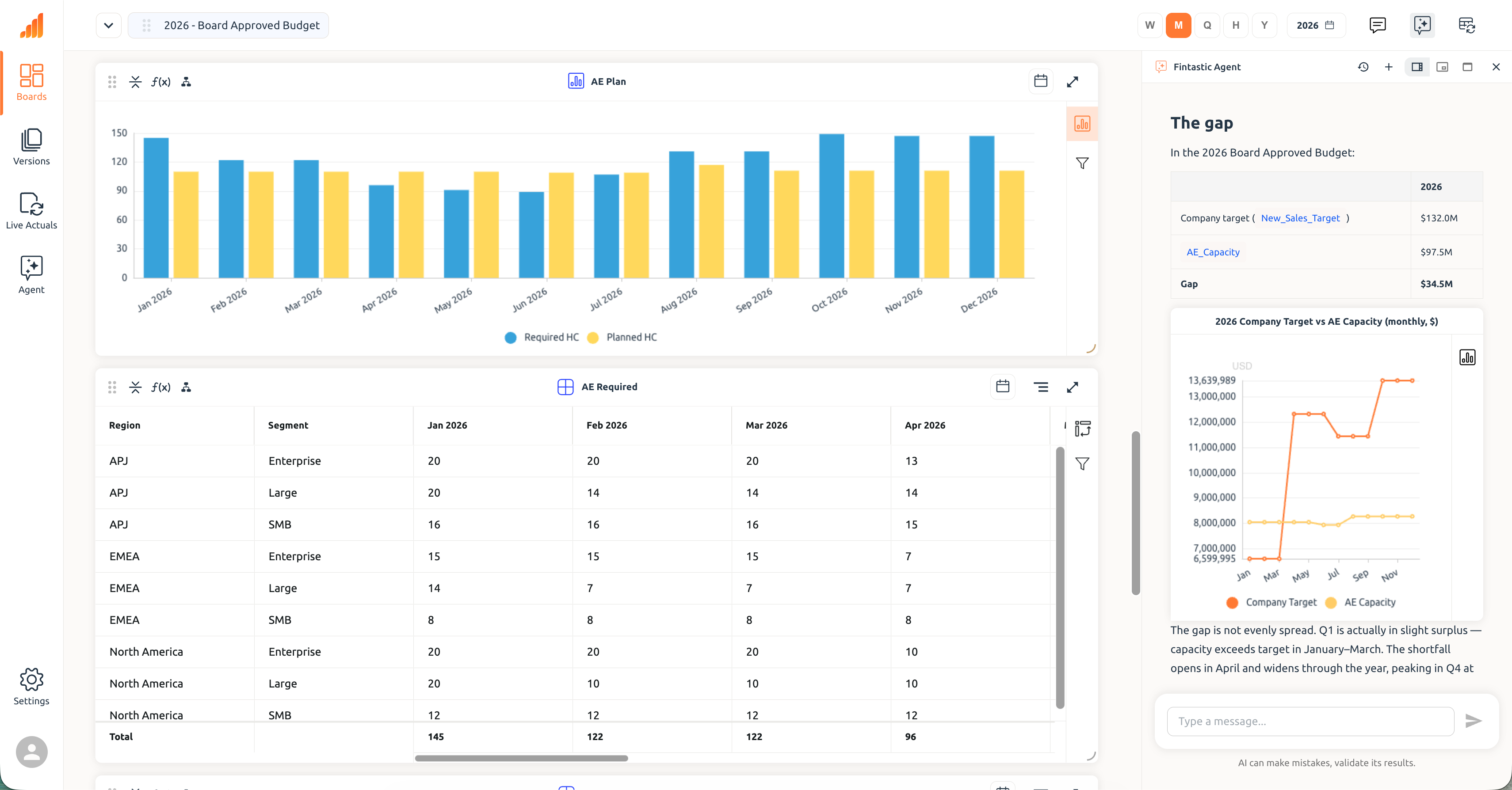
The Agent on a capacity planning board
We value your privacy

We use cookies to enhance your browsing experience, serve personalized ads or content, and analyze our traffic. By clicking "Accept All", you consent to our use of cookies.

Cookie preferences