
Fintastic is an enterprise planning and analysis (FP&A / EPM) platform engineered architecture-first: a density-agnostic engine for sub-second calculations, unlimited concurrent scenarios, and a single model that handles enterprise-scale complexity without compromise.
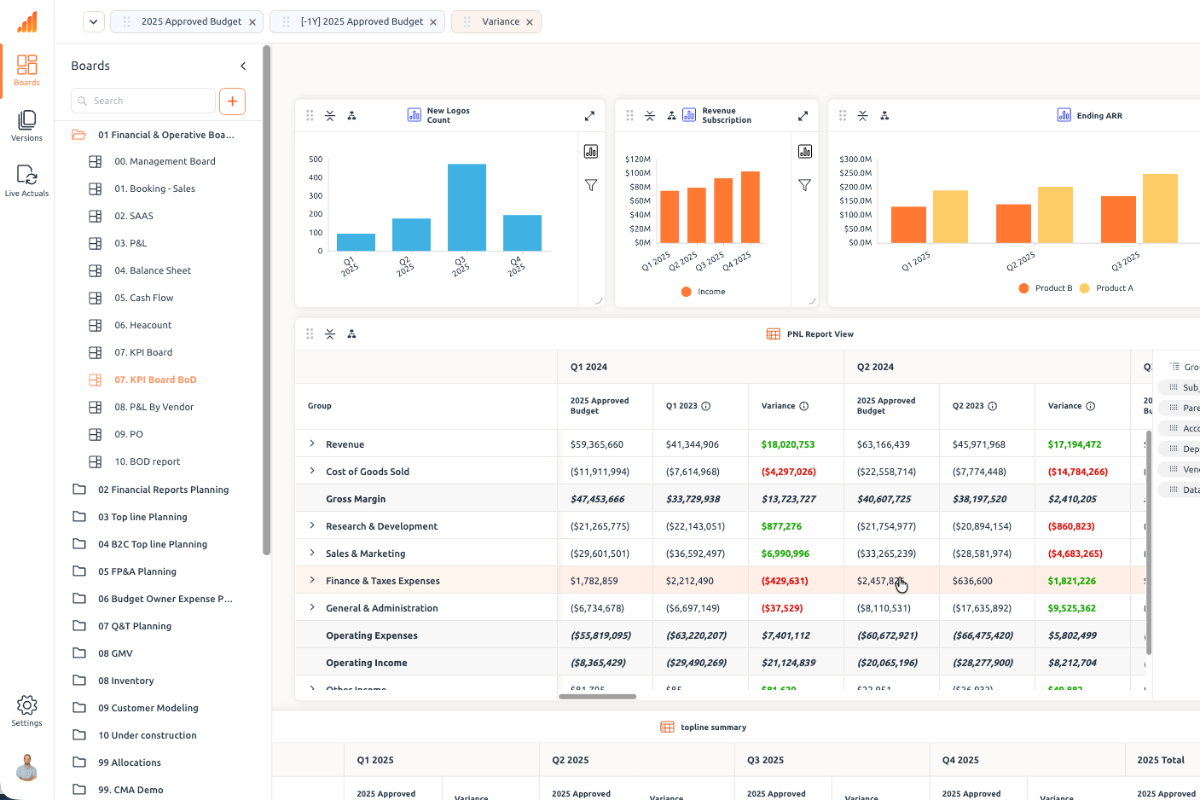
Models split. Performance slows. Scenarios become a luxury teams cannot afford. The patterns are familiar, and they are not team problems:
⏱
The requirement is seconds, but recalculations stretch into minutes or hours as datasets grow.
▦
Logic scattered across files, modules, and disconnected sheets just to keep the platform usable.
⚡
Concurrency during planning cycles causes the platform starts to lock up.
↻
Long planning cycles inside a company that needs instant answers.
These aren't team problems. They're architecture problems.
Fintastic was built from the ground up to remove them.
02 / Computation engine
Most platforms pick one approach. Dense works on small datasets. Sparse scales only while data stays sparse. Both degrade as dimensionality and calculation count grow. Fintastic routes each calculation to the optimal path automatically.
A real working model: Cloud Spend, Resource Utilization, Cost per GPU, and Unit Economics recalculating together in seconds, not one board at a time.
01 · dense
Optimized for populated cubes where most dimensional intersections contain values. Typical in consolidated financial models and high fill-rate operational datasets.
02 · sparse
Optimized for large dimensional spaces that are selectively populated. Proven in production well beyond the industry-standard limits of 2³² or 2⁶⁴ combinations.
03 · routing
The engine evaluates data characteristics at the calculation level. Dense and sparse representations convert freely, so they compute together in a single operation.
Multi-entity models are calculated in a single operation, not entity-by-entity. Calculations complete in seconds regardless of model size, dimensionality, or concurrent user count. This is not a performance target. It is an architectural characteristic.
03 / Adaptive modeling
Traditional platforms impose structural constraints: predefined dimensions, rebuilds on schema changes, new models for every new business line. Fintastic eliminates that trade-off.
✓
Arbitrary dimensionality
No hard limit on dimensions, members, or hierarchical depth. No need to create artificially concatenated dimensions.
✓
Flexible schema
Structure follows your business logic, not platform module boundaries. No rigid templates.
✓
Single model instance
Finance, revenue, workforce, marketing, IT, and operations live in one model. Change one assumption and every dependent calculation updates immediately.
✓
Structural evolution without rebuilds
Add a product line, enter a market, or reorganize. The model adapts. You do not start over or call a consultant to restructure.
Finance
Revenue
Workforce
One Model
Marketing
IT
Operations
04 / Versioning architecture
On most platforms, scenarios share compute and memory, so adding versions degrades performance and locks users out. Fintastic works differently.
.png)
Multiple budget versions and best and worst cases compared side by side, each recalculated independently.
Legacy platforms
Fintastic
Versions share memory and compute
Each version is fully isolated
Adding versions slows the platform
Performance stays constant at any version count
Comparing versions requires matching structure and dimensionality
Compare versions across different structures, dimensions, and data automatically
Users are locked out during calculations
Users can perform parallel updates across all versions simultaneously
Cloning takes minutes or hours
Near-instant cloning with all logic and structure preserved
3–5 active scenarios is a practical limit
No limit on concurrent versions
05 / Data architecture
Continuous synchronization keeps the model live. Only what changed is processed, so updates are fast and the numbers are always current.
New and changed records are detected and ingested continuously. The platform does not reload entire datasets to reflect an update.
Only the calculations affected by a change are recomputed. A single actuals update does not trigger a full-model recalculation.
Drill to the source journal entry
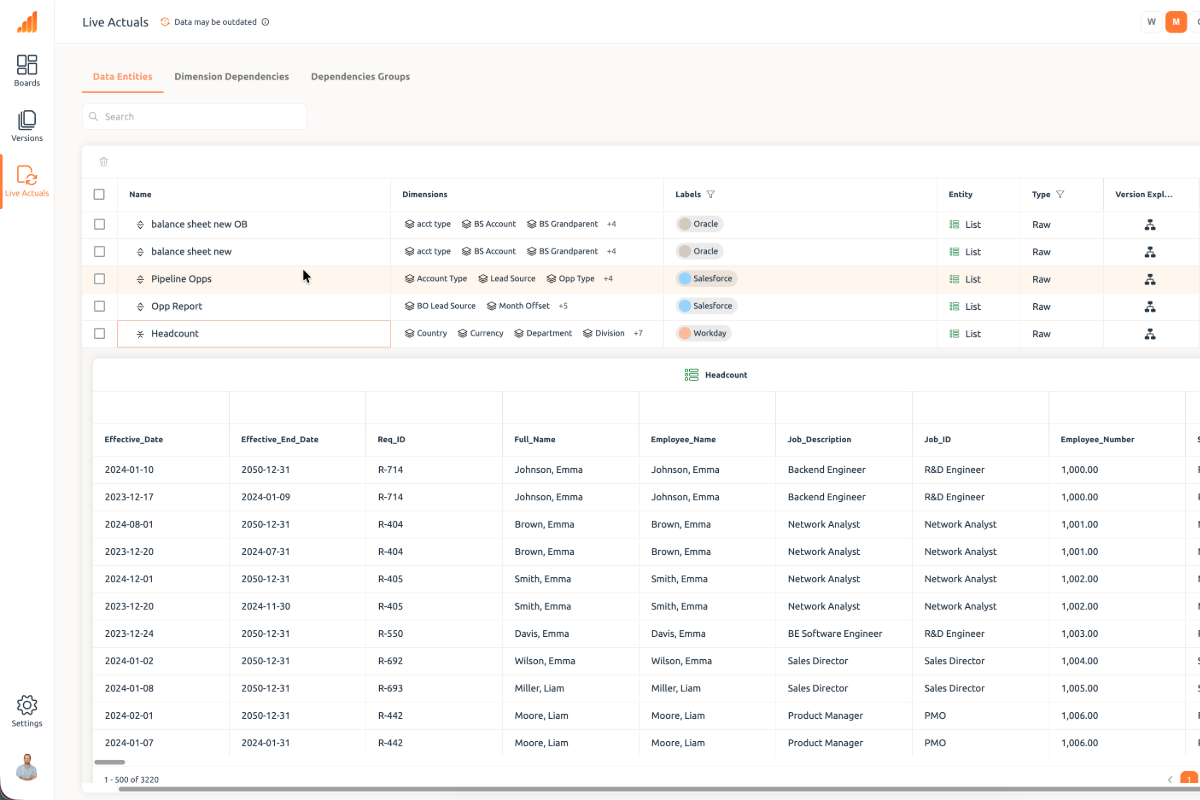
Live actuals flow into the P&L with drill-down all the way to the source transaction.
Pre-built integrations
Native and API connections to the systems you already run:
NetSuite
Salesforce
Workday
SAP
Google BigQuery
Snowflake
REST API
CSV
06 / Modeling language
Expressive enough for complex logic, approachable enough that analysts build and own models without engineering support.
AI-explained formulas
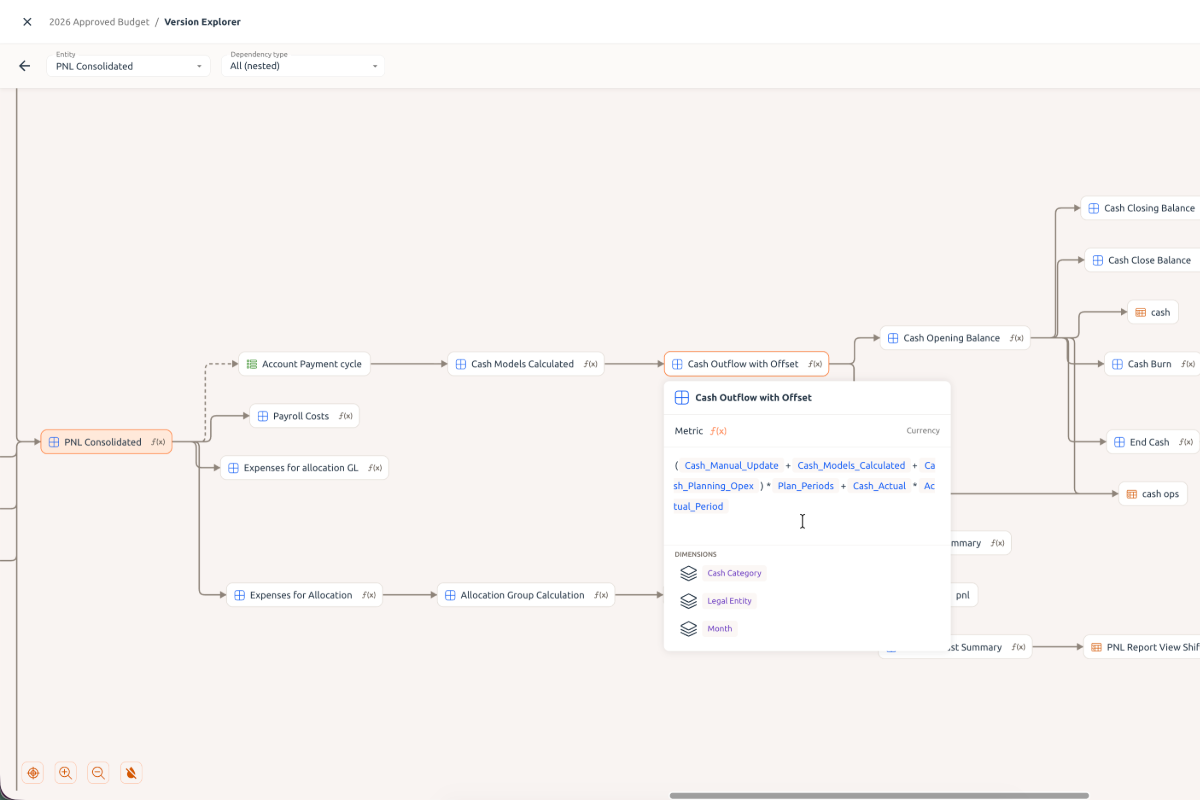
Readable formulas with AI assistance, built and maintained by the finance team.
Handles complex, multi-dimensional business rules without workarounds or external scripts.
Most modeling is done through a visual, spreadsheet-familiar interface, not a programming environment.
Describe the intent and the platform helps construct, validate, and explain the formula.
New builders reach production-grade output in three to four weeks, not months.
07 / Embedded intelligence · Smartastic
Smartastic works on the same data, formulas, and permissions your team uses every day. No separate data layer, no exported copy, no hallucinated numbers.
Answers from the live model
Answers from the live model
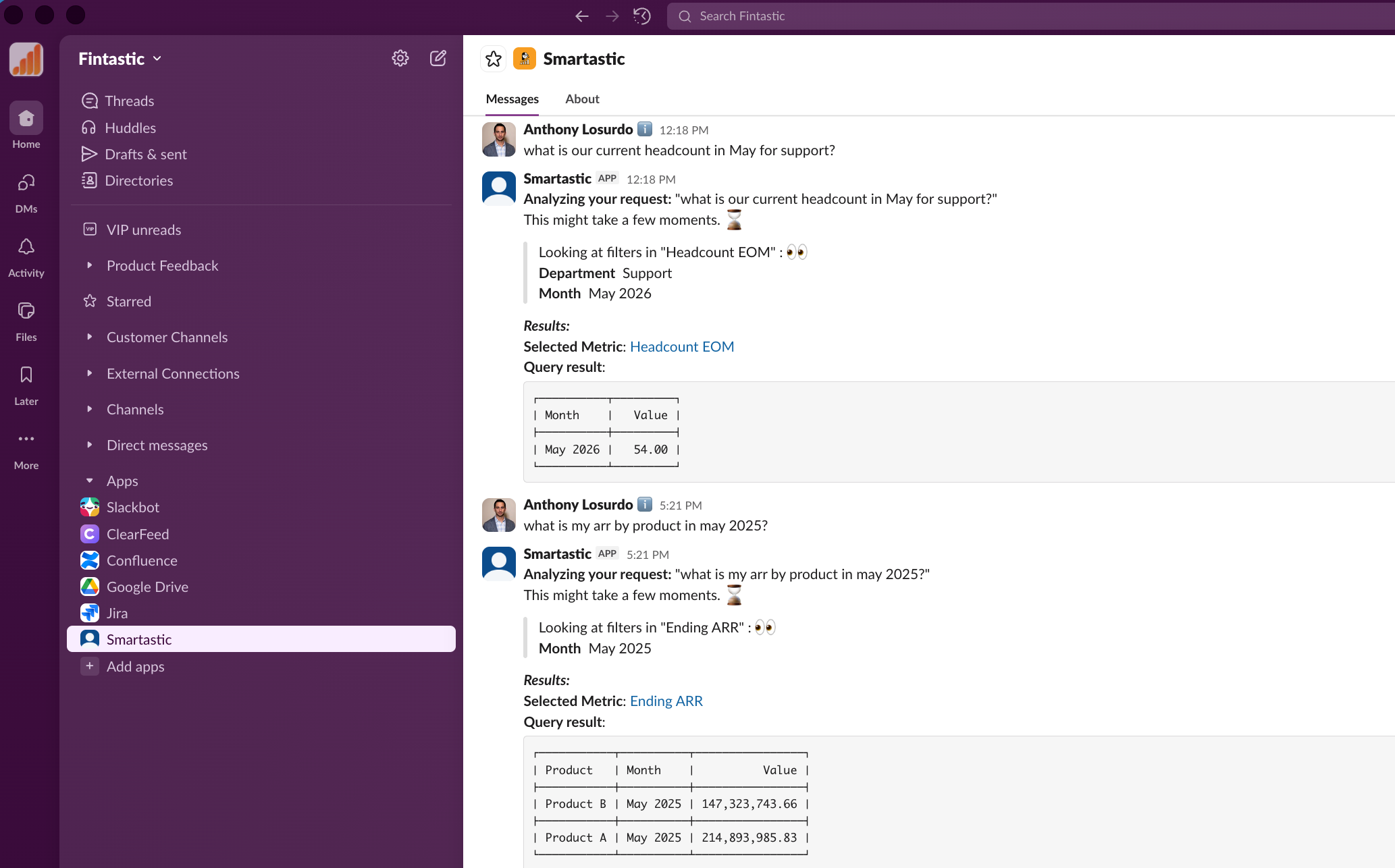
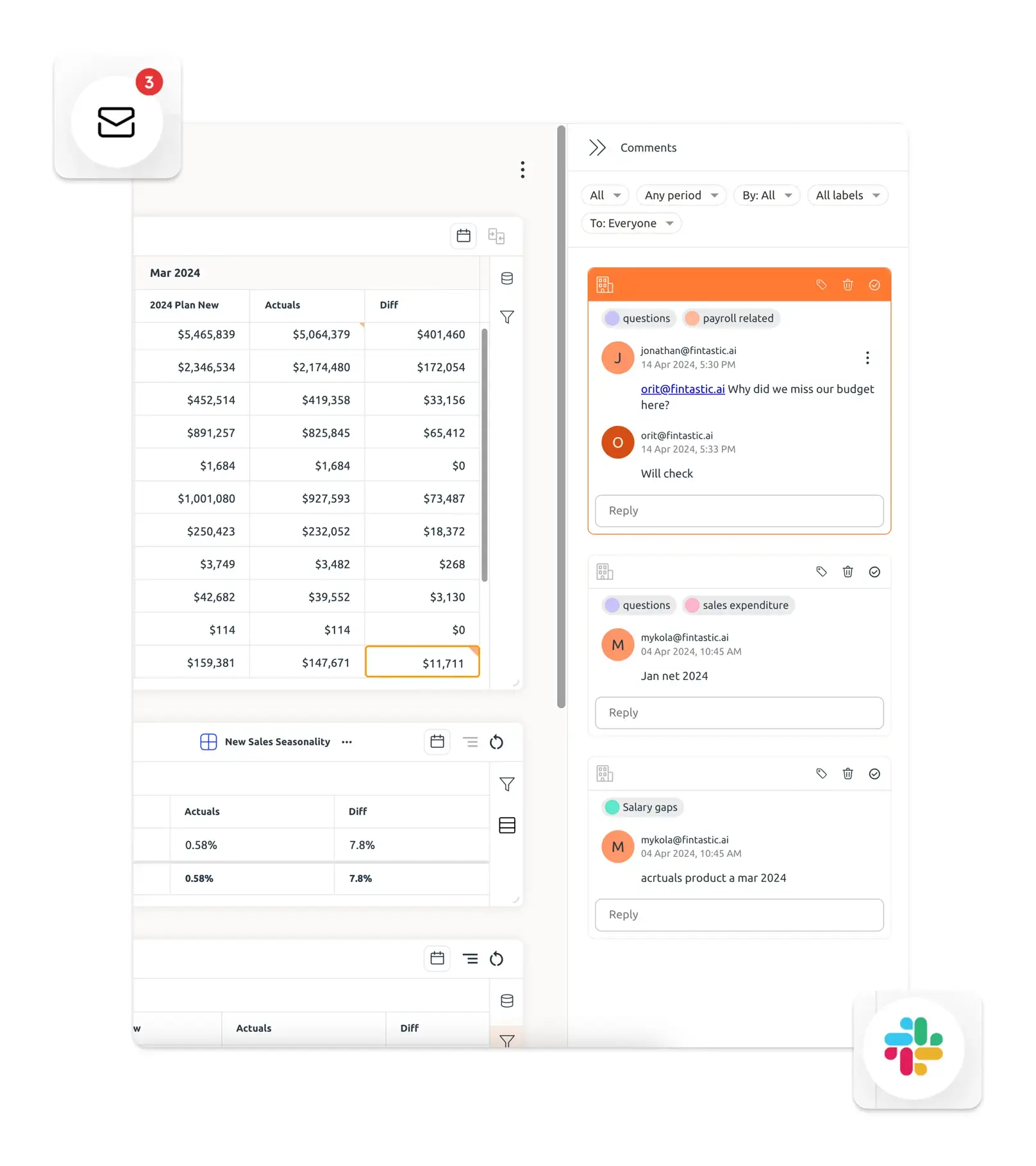
Ask in plain language. Smartastic answers from the live model, with the logic behind every number.
structural awareness
Understands dimensional structure and formula dependencies, so answers reflect how the model actually works.
permission-aware
Respects entity and dimension-level permissions, not as a post-filter. Users only see what they are allowed to see.
natural language
Ask questions in plain language inside the tools you already use, including Slack.
formula assistant + docs
Builds and explains formulas and generates model documentation on demand.
Every answer is grounded in the live model, so the number you get is the number in the plan.
See Smartastic in action →08 / Governance & security
Control, isolation, and auditability are structural characteristics of the platform, not bolt-on features.
✓
Cell-level permissions across entities and dimensions
✓
Data masking for sensitive figures
✓
Version isolation with role-based access control
✓
SSO and complete audit trails
SOC 2 Type II
ISO 27001
AWS infrastructure
Encryption in transit and at rest
Continuous monitoring
Annual disaster-recovery testing
09 / Measured performance
These are outcomes from production implementations, not lab benchmarks.
from 15 min
13 sec
Scenario calculation
~98% faster
from 5 models
1 model
Unified forecasting
Fully consolidated
from 2-5 users
Unlimited
Concurrent users
No user ceiling
from ~1 hr
<5 min
Actuals import
~90% faster
from 15 min
<3 min
BigQuery export
~80% faster
from 3 months
3-4 wks
Builder onboarding
~70% faster
10 / Technical FAQs
Yes. The adaptive modeling architecture supports arbitrary dimensionality without rigid modular constraints, so your entire business can operate within a single model instance. In one enterprise implementation, a customer consolidated 5 disconnected models into 1 fully interconnected model with no performance trade-offs.
We encourage structured proof-of-concept evaluations using your actual data and requirements. In these evaluations, Fintastic has consistently delivered results in seconds, with customers reporting calculation improvements of up to 80x. We can set up a POC so you benchmark performance directly against your current platform.
The platform is self-serve and low-code. In enterprise implementations, internal teams have driven 80 to 90% of the build. Model builders with no prior planning-platform experience have onboarded in 3 to 4 weeks and built production-grade structures independently.
Smartastic operates directly inside the model, on the same data, formulas, and permission structures your team uses every day. It understands dimensional structure and formula dependencies and respects entity and dimension-level permissions natively, so there are no hallucinated numbers and full traceability.
Unlimited concurrent users in complex enterprise models, with no degradation. The architecture handles parallel access natively, with no locking, no queuing, and no version conflicts.
Yes. The adaptive modeling architecture supports arbitrary dimensionality without rigid modular constraints, so your entire business can operate within a single model instance. In one enterprise implementation, a customer consolidated 5 disconnected models into 1 fully interconnected model with no performance trade-offs.
We encourage structured proof-of-concept evaluations using your actual data and requirements. In these evaluations, Fintastic has consistently delivered results in seconds, with customers reporting calculation improvements of up to 80x. We can set up a POC so you benchmark performance directly against your current platform.
The platform is self-serve and low-code. In enterprise implementations, internal teams have driven 80 to 90% of the build. Model builders with no prior planning-platform experience have onboarded in 3 to 4 weeks and built production-grade structures independently.
Smartastic operates directly inside the model, on the same data, formulas, and permission structures your team uses every day. It understands dimensional structure and formula dependencies and respects entity and dimension-level permissions natively, so there are no hallucinated numbers and full traceability.
Unlimited concurrent users in complex enterprise models, with no degradation. The architecture handles parallel access natively, with no locking, no queuing, and no version conflicts.
Bring your real models and data. We will run a proof of concept and show you the performance, the scenarios, and the AI on your own numbers.